Available Technologies
# of Displayed Technologies: 4 / 4
Applied Category Filter (Click To Remove): Small Molecules
Clinical Stage EAAT2 Activator LH-001 for Treatment of Alzheimer’s Disease, ALS and Epilepsy
TS-075262 — PROBLEM
Alzheimer’s disease is a progressive brain disorder that destroys memory and thinking, affecting 6–7 million people in the U.S. and over 50 million worldwide. There is currently no cure, and available treatments only temporarily manage symptoms or modestly slow disease progressi…
- College: College of Medicine (COM)
- Inventors: Lin, Chien-Liang
- Licensing Officer: Schworer, Adam
 Mps1/TTK Inhibitors for Cancer Therapy
TS-075231 — Problem
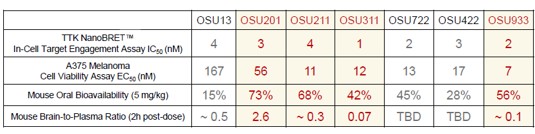
Despite recent progress in cancer therapy, acquired resistance to existing cancer drugs reduces therapeutic efficacy. There is a strong need for a therapy with a novel mode of action to overcome drug resistance, and to improve therapeutic efficacy whether used alone or in combination therap…
- College: Office of Health Sciences
- Inventors: Hilinski, Gerard; Alverez, Celeste; Wilson, Tyler
- Licensing Officer: Schworer, Adam
 Dual Androgen Receptor/AKR1C3 Inhibitors for Prostate Cancer
TS-062605 — The Need:
Castration-resistant prostate cancer (CRPC) poses a significant challenge in oncology, with existing therapies often leading to resistance and disease progression. Key drivers of resistance include the androgen receptor (AR) and aldo-keto reductase family 1 member C3 (AKR1C3). Novel treat…
- College: College of Pharmacy
- Inventors: Li, Pui-Kai "Tom"; Cheng, Xiaolin; Kong, Xiaotian; Xing, Sam
- Licensing Officer: Schworer, Adam
Translational Activators of the Glutamate Transporter EAAT2 to Treat Neurological and Psychiatric Diseases
TS-043938 — Small molecule technology with novel translational activation mechanism.
Glutamate is a major neurotransmitter in the mammalian central nervous system (CNS) and essential for normal brain function including cognition, memory, and learning. However, the extracellular concentration of glutamate must remain below excitotoxic levels (~ 1 μM) to avoid overstimulation of …
- College: College of Medicine (COM)
- Inventors: Lin, Chien-Liang
- Licensing Officer: Schworer, Adam